

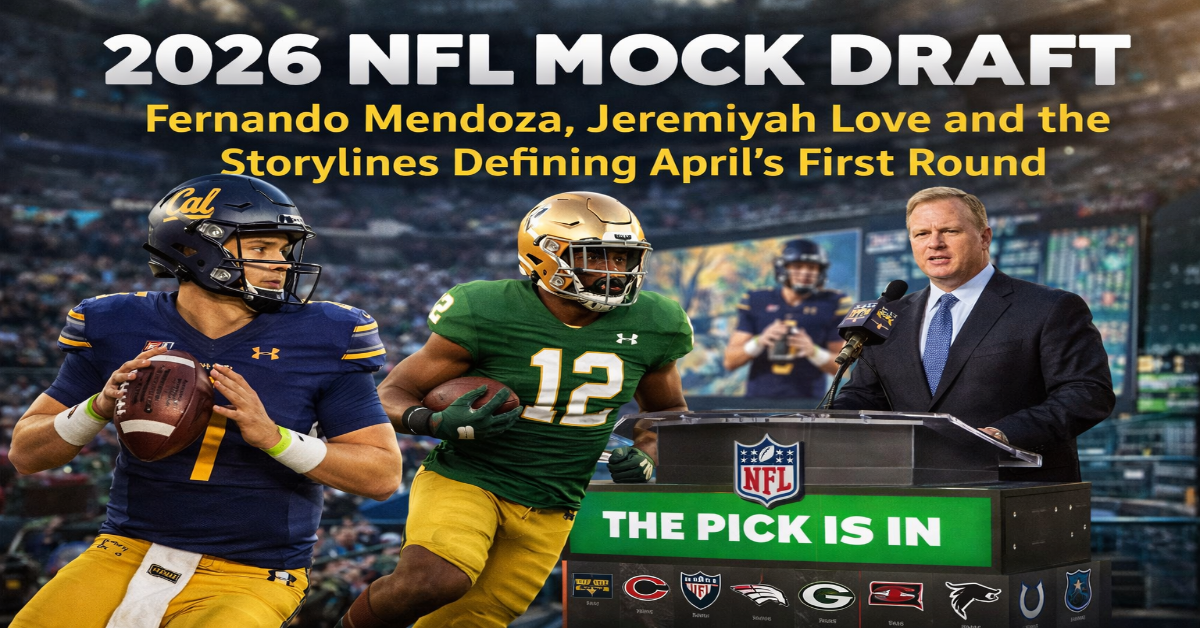
Mock drafts are exercises in probability management. Most years, the first several picks involve genuine uncertainty — multiple quarterbacks, positional debates, surprise trades. The 2026 cycle is different. The Raiders’ situation at No. 1 has been settled since roughly Week 10 of the college football season, and free agency has only reinforced that conclusion.
Mel Kiper Jr. called the No. 1 selection “just a formality at this point,” noting that the Raiders have spent the past two weeks clearing the runway for Mendoza’s arrival — signing center Tyler Linderbaum to a three-year, $81 million deal and trading Geno Smith to the Jets. The Raiders’ organizational alignment around Mendoza is unusually complete for this stage of the draft calendar.
What makes the 2026 draft genuinely interesting is everything that happens after the obvious. Where does Jeremiyah Love land? What do the Jets do with two top picks? Do Arizona and Tennessee take the best available defender or chase different positional value? And how sharply do Jeremiah and Kiper diverge once you get past the locked pick at No. 1?
Free agency also added complexity that early mocks couldn’t account for. Teams that were projected Love landing spots in the mid-first round — Kansas City and New Orleans — both added veteran running backs, effectively pushing Love’s board position upward rather than making him redundant. Understanding the 2026 draft requires tracking not just talent, but organizational context and the analyst frameworks being applied to it.
Fernando Mendoza: The Consensus QB1
Profile and Play Style
Fernando Mendoza’s rise has been one of the cleaner quarterback evaluation stories in recent draft history. Leading Indiana to a 16-0 national championship season, he demonstrated elite pocket processing, timing-based accuracy, and decision-making efficiency that held up across every major opponent on the schedule — Ohio State, Alabama, Oregon, and Miami all failed to expose consistent breakdowns in his game.
His adjusted completion percentage of 79.2% ranked second in the country in 2025. He threw 41 touchdowns against 6 interceptions, posted 27 red-zone touchdowns without a single interception — best in the FBS, three ahead of the nearest competitor — and generated a PFF passing grade of 90.7. The red-zone efficiency figure is particularly notable: it reflects not just accuracy but decision-making discipline under compressed field conditions, which translate directly to NFL demands.
PFF’s scouting profile describes Mendoza’s football IQ, ball placement, and football character as top-class, making him worthy of an early-impact projection and potential franchise quarterback designation. Scouts frequently compare him stylistically to Carson Palmer and Jared Goff — quarterbacks who succeeded through processing speed and placement rather than elite athleticism.
Fernando Mendoza: 2025 Season Metrics
| Metric | 2025 Value |
| Passing Yards | 3,535 |
| Touchdowns | 41 |
| Interceptions | 6 |
| Completion % | 72.0% |
| Adjusted Completion % | 79.2% |
| Red Zone TDs (0 INTs) | 27 |
| PFF Passing Grade | 90.7 |
| Snaps Under Center | 3% |
| Rushing Touchdowns | 7 |
System Risk: The Under-Center Limitation
The single most under-discussed technical risk in Mendoza’s profile is his near-total absence of under-center snaps. He took only 3% of his snaps from under center in 2025, operating out of the shotgun on virtually every play. NFL play-action is most effective when launched from under center — pre-snap run fakes alter defensive back leverage in ways that shotgun play-action cannot replicate with the same consistency.
That adaptation is not cosmetic. It typically requires a full off-season of installation and at least one training camp before a shotgun-native college quarterback can execute NFL play-action at the cadence and depth that Klint Kubiak’s system will require. Additionally, when Indiana’s offensive line allowed early pressure, Mendoza’s deep-ball accuracy declined measurably — a pattern that will require structural protection from the Raiders’ line to manage effectively in Year 1.
The Linderbaum signing is, at least in part, an architectural response to this. A veteran center with elite processing ability functions as a cognitive extension for a young quarterback still adapting to NFL pre-snap reads. Las Vegas is betting that infrastructure investment can compress Mendoza’s adjustment timeline.
Jeremiyah Love and the Running Back Revaluation
No storyline in the 2026 draft cycle cuts against recent NFL orthodoxy more directly than the Jeremiyah Love debate. Running backs have been systematically devalued at the top of drafts since roughly 2019. Positional surplus, shorter career arcs, and the perceived replaceability of the position have pushed consensus toward using premium capital on pass-rushers and offensive linemen. Love is forcing a re-examination of that framework.
Love led all of college football with 35 rushing touchdowns and 40 touchdowns from scrimmage across the 2024 and 2025 seasons. He went from averaging 70.3 rushing yards per game in 2024 to 114.3 in 2025, becoming just the sixth player in FBS history with multiple seasons averaging over 6.5 yards per carry while accumulating at least 15 rushing touchdowns each year. He ran a 4.36 in the 40-yard dash at the combine at 214 pounds.
Todd McShay stated that Love remains his No. 1 overall player after the combine, noting the only other running back who came close to being listed as his top prospect was Bijan Robinson. Kiper, in his Mock 3.0 released March 17, moved Love from No. 9 all the way to No. 4 to the Tennessee Titans — the biggest single-mock jump of any player at the top of the board. His note on the pick cited Tennessee’s commitment to building around second-year quarterback Cam Ward, and Love’s physical and testing similarities to Jahmyr Gibbs when Gibbs was a prospect in 2023.
The free agency movement accelerated Love’s climb rather than suppressing it. Kansas City signed a veteran running back in free agency, and New Orleans did the same — removing two logical mid-first-round landing spots from the conversation. The downstream effect pushed Love higher on the boards of teams sitting at 3, 4, and 5, as the signal from KC and New Orleans suggested those teams had intelligence suggesting Love would not fall to them anyway.
Post–Free Agency Round 1 Consensus: Top Projected Picks
| Pick | Team | Projected Player | Position | Key Context |
| 1 | Las Vegas Raiders | Fernando Mendoza (Indiana) | QB | Heisman winner; Linderbaum signed; Mendoza era begins |
| 2 | New York Jets | David Bailey (Texas Tech) / Arvell Reese (Ohio St.) | EDGE/LB | Kiper: Bailey. Jeremiah: Reese. Jets need immediate edge impact |
| 3 | Arizona Cardinals | Rueben Bain Jr. (Miami) / Arvell Reese | EDGE | Pass-rush priority; BPA approach post-combine |
| 4 | Tennessee Titans | Jeremiyah Love (Notre Dame) | RB | Kiper & Jeremiah both now project Love to Nashville |
| 5 | New York Giants | Sonny Styles (Ohio St.) / Caleb Downs | LB/S | Harbaugh era; Love visited March 14; Downs also in play |
| 7 | Washington Commanders | Sonny Styles (Ohio St.) | LB | Elite combine athlete; Kiper projects here post-free agency |
| 9 | Kansas City Chiefs | Rueben Bain Jr. (Miami) | EDGE | KC holds two first-round picks; edge a major need |
| 10 | Chicago Bears | Zion Young (Missouri) | EDGE | Chicago hasn’t used top-50 pick on edge since 2016 |
Sources: Kiper Mock 3.0 (ESPN, March 17, 2026); Jeremiah Mock 3.0 (NFL.com, March 17, 2026); PFF, Pro Football Network, theScore, Bleacher Report.
Daniel Jeremiah vs. Mel Kiper: Diverging Draft Philosophies
The Jeremiah-Kiper divergence in the 2026 cycle is more analytically substantive than the typical analyst disagreement. The two approaches differ not just on individual player rankings but on the underlying framework for evaluating an unconventional class.
Methodology Comparison
| Dimension | Daniel Jeremiah (NFL Network) | Mel Kiper (ESPN) |
| Core Framework | Scheme fit and positional role clarity | Talent ceiling and athletic upside |
| QB Evaluation | Conservative; one QB projected in Round 1 | Aggressive; monitors Ty Simpson (Alabama) for Round 1 entry |
| Love Projection | No. 4 (Titans) — Mock 3.0 | No. 4 (Titans) — Mock 3.0 (moved from No. 9) |
| Jets at No. 2 | Arvell Reese (LB/EDGE, Ohio St.) | David Bailey (EDGE, Texas Tech) |
| Defensive Priority | High — edge and LB dominate top 10 | Moderate — willing to let BPA dictate more |
| Combine Influence | Moderate; film remains primary driver | High; Bailey’s combine performance drove his rise |
| Round 2 Approach | Receiver depth; 6 WRs projected in Round 1 | OL urgency; tackle run expected in Round 2 |
Where the Split Matters Most
The most consequential divergence is at Pick 2. Jeremiah has consistently projected Arvell Reese — who he describes as versatile and athletic, with ability to play from the edge or off-ball — to the Jets. Kiper shifted from Reese to Bailey after the combine, citing Bailey’s elite testing as among the best performances by a defensive end prospect over the past four decades.
That difference reflects deeper philosophical frameworks. Jeremiah’s preference for Reese is rooted in multi-positional deployment value — Aaron Glenn can use Reese as a chess piece in multiple sub-packages. Kiper’s pivot to Bailey reflects a raw ceiling argument: elite athletic testing at a premium position, combined with strong production at Texas Tech, gives Bailey a higher floor-to-ceiling ratio regardless of immediate scheme fit.
Both analysts now agree on Love at No. 4, which is itself a significant development — it means the running back revaluation argument has achieved genuine cross-methodology consensus, not just isolated support from one analyst’s framework. When both Jeremiah and Kiper land in the same place on a structurally unconventional pick, the market signal is hard to dismiss.
The secondary divergence involves Ty Simpson’s first-round potential. Kiper has expressed explicit concern about the Alabama quarterback’s readiness while keeping the door open for a Round 1 selection if Simpson’s pro day performance warrants it. Jeremiah has maintained one quarterback in Round 1 across all three of his mocks. That gap becomes consequential for teams at Picks 12–18 who need a quarterback and are weighing whether to reach for Simpson or address other needs and revisit quarterback in Round 2.
2026 Draft Class: Positional Strength Analysis
| Position Group | Class Depth | Top-End Talent | Round 1 Expected Picks | Key Names |
| QB | Weak | Moderate | 1 | Mendoza; Simpson (borderline R1) |
| EDGE | Elite | High | 5–7 | Bailey, Bain Jr., Reese, Faulk, Young |
| Safety | Strong | High | 3–4 | Downs, McNeil-Warren |
| LB | Strong | High | 2–3 | Styles, Reese (hybrid) |
| WR | Deep | Moderate-High | 5–7 | Tate, Boston, Lemon, Cooper, Tyson |
| RB | Unexpectedly strong | Elite (Love) | 1–2 | Love, Price |
| OT | Moderate | High ceiling | 3–5 | Lomu, Freeling, Ioane |
| DT/iOL | Strong | Moderate | 2–3 | Woods, multiple Day 2 targets |
Positional scarcity at quarterback is distorting Round 1 value distribution. When only one quarterback has a first-round consensus grade, teams requiring a signal-caller face a binary choice: pay a premium for Mendoza (impossible — he’s going No. 1) or accept that 2026 is not their quarterback class and build around positional needs instead.
Round 2 Projections: Where the Draft Gets Interesting
Round 2 is where the 2026 draft becomes strategically rich. The quarterback scarcity that defines Round 1 creates downstream pressure — multiple teams will enter Round 2 having not addressed their signal-caller need, creating the conditions for a quarterback run in the 33–50 range.
Expected Round 2 Trends
- A second quarterback — most likely Ty Simpson (Alabama) or a developmental prospect — is expected to come off the board in the 35–50 range. Simpson’s pro day on March 19 in Tuscaloosa will either confirm or deflate his first-round case, but his ceiling keeps him relevant through at least Pick 50.
- Offensive tackle becomes a Round 2 priority for multiple teams. Matt Miller’s two-round mock projects a tackle run between Picks 33–55, driven by the Colts, Ravens, Panthers, and Browns all seeking line upgrades. Monroe Freeling (Georgia) and Caleb Lomu (Washington) are the consensus names in this range.
- Slot receiver depth emerges as a Round 2 strength. Prospects with elite separation metrics — measured by average target separation at the combine — cluster in the 45–70 range. Miller specifically flagged that this year’s slot class is unusually strong, with multiple players generating Amon-Ra St. Brown comparisons in terms of route-running craft and contested-catch ability.
- Developmental linebackers and interior defensive linemen fill the 50–64 range, where teams with defensive rebuild needs — Cleveland, Carolina, Atlanta — have been most active in pre-draft visits.
- The Jets’ Pick 16 adds another strategic layer: Jeremiah projected them taking Indiana wide receiver Omar Cooper Jr. here in Mock 3.0, pairing a rotational target with Geno Smith. That selection would represent a short-term floor investment rather than a ceiling pick, and whether Aaron Glenn concurs with that philosophy will define how the Jets use their second first-rounder.
The broader Round 2 pattern reflects the structural imbalance of the class. When Round 1 is dominated by defensive players and one quarterback, Round 2 absorbs the offensive positional needs that teams couldn’t address on Thursday night. Offensive tackle, receiver depth, and developmental quarterback will define Friday’s board in Pittsburgh.
Strategic Implications: What the Consensus Gets Wrong
Three under-examined dimensions are shaping the 2026 draft in ways that standard projections don’t fully capture.
1. Mendoza’s Under-Center Adaptation Timeline
Most mock draft analysis treats Mendoza’s transition to under-center mechanics as a minor footnote. It is not. NFL play-action efficiency — particularly in Kubiak’s system, which is built around run-game deception — depends on the pre-snap movement discipline that only develops through consistent under-center reps. The Raiders should not expect Kubiak’s full offensive install to function at professional pace until midseason at the earliest. Week 1 readiness is an organizational aspirational goal, not a structural certainty.
2. Positional Value Misallocation in Rebuilding Contexts
The teams most likely to take Love in the top 5 — Arizona and Tennessee — are also organizations in active offensive rebuilds. Using a top-5 pick on a running back in a rebuilding context distributes positional improvement asymmetrically. Love makes a developing quarterback look better by creating easier run-pass conflicts and reducing third-and-long frequency, but he does not address the core infrastructure gaps — offensive line depth, second receiving option, pass-rush presence — that those franchises need to resolve for long-term competitiveness.
3. The Caleb Downs Positional Compression
Downs recorded 8 interceptions in 2025, demonstrated sideline-to-sideline range, and has graded as an elite defensive back prospect since his freshman season at Alabama. Multiple analysts consider him the most complete player in the class on pure talent. The only reason he projects outside the top 5 is positional value suppression — safeties rarely command premium capital regardless of individual merit. Teams drafting in the 6–10 range are getting genuine top-5 talent at a positional discount, and the franchise that lands Downs will likely look back at his selection as the clearest value of the 2026 cycle.
The Future of the 2026 NFL Draft Class in 2027
The 2026 class will be evaluated by a different set of metrics once actual NFL production begins. Two dynamics will define how history judges these picks.
First, the quarterback premium will be tested immediately. Mendoza enters a conference-championship-caliber AFC West and will face Patrick Mahomes, Bo Nix, and Justin Herbert in his first professional season. The learning curve for shotgun-heavy college quarterbacks converting to NFL under-center demands has improved with modern analytics-driven coaching staffs, but the 12–18 month timeline for consistent performance is relatively constant regardless of support infrastructure. If Mendoza struggles in 2026, the Raiders’ soft-landing strategy — Linderbaum, Jeanty, Bowers — may delay the scrutiny. But the expectations in Las Vegas have been reset aggressively.
Second, the running back revaluation argument will be confirmed or discredited by what Love does in his first two seasons. If Love produces at the level of Bijan Robinson’s rookie year and remains healthy, the draft community’s willingness to use top-5 capital on the position will solidify for the first time since 2018. If he faces the same durability or positional-value questions that have haunted the position since Todd Gurley’s knee issues, the pendulum swings back.
By 2027, the 2026 NFL Mock Draft analytics infrastructure surrounding draft evaluation will be more sophisticated. Teams are already investing in AI-driven player evaluation models, biometric tracking of college prospects, and predictive injury modeling that goes beyond traditional combine measurements. The 2027 cycle will likely reflect greater reliance on multi-year physical data rather than one-week combine snapshots — which may reduce the kind of board volatility that Bailey’s combine performance created in 2026.
The more 2026 NFL Mock Draft nuanced question won’t be whether Mendoza was worth No. 1 — it almost certainly will have been — but whether the teams that passed on Love in favor of pass-rushers made the structurally correct call for their specific franchise contexts. That answer will emerge by mid-2027, when Love’s first season is complete and the edge rushers taken around him have had time to establish their NFL baselines.
Key Takeaways
- Fernando Mendoza is the most consensus No. 1 pick in years, with genuine supporting infrastructure being built around his arrival in Las Vegas.
- Jeremiyah Love’s combine showing and free agency movement have elevated him into genuine top-5 territory — the first running back to achieve this draft momentum since Saquon Barkley in 2018.
- Jeremiah and Kiper now agree on Love at No. 4 but diverge sharply at No. 2 — Reese (Jeremiah) vs. Bailey (Kiper) — reflecting deeper philosophical splits on scheme fit versus athletic ceiling.
- The Linderbaum signing is a coaching-infrastructure decision as much as a football one, designed to reduce cognitive load on a shotgun-native quarterback transitioning to NFL demands.
- Round 2 will be defined by a second quarterback run (Simpson range), an offensive tackle surge, and strong slot receiver depth that most Round 1 projections overlook entirely.
- Caleb Downs represents the class’s clearest positional-value discount — top-5 talent suppressed by safety’s historical draft position, and a likely steal for whoever takes him in the 6–10 range.
- The Jets’ dual first-round picks create the draft’s most interesting strategic tension: build for Geno Smith’s immediate ceiling or invest in long-term defensive infrastructure under Aaron Glenn.
Conclusion
The 2026 NFL Mock Draft arrives in Pittsburgh with an unusual combination of clarity at the top and genuine chaos through the middle of Round 1. Fernando Mendoza’s path to Las Vegas is settled. What happens between picks 2 and 32 is not — and the Jeremiah-Kiper divergence at No. 2 alone illustrates how much analytical framework shapes what looks like a converging consensus.
Jeremiyah Love’s ascent has reintroduced a debate that the NFL had largely tabled — whether elite running backs deserve premium capital — and the answer teams give on draft night will reveal something important about how franchise-building philosophy has evolved in the analytics era. The post-free agency board is still shifting. Pro days, most notably Georgia on March 19 and Alabama on the same date, will generate information that reshapes final valuations before April 23.
What the current consensus 2026 NFL Mock Draft establishes clearly is this: the Raiders have the quarterback they have needed for a decade, the Jets have the draft capital to accelerate their rebuild in any direction they choose, and the teams sitting at 3, 4, and 5 face the most consequential decisions of the cycle. April in Pittsburgh will settle the debates that March can only frame.
Methodology
This article draws on scouting data from Pro Football Focus (PFF), ESPN draft analysts including Mel Kiper Jr. (Mock 3.0, March 17, 2026), Matt Miller, Jordan Reid, and Field Yates; NFL.com mock drafts from Daniel Jeremiah (Mock 3.0, March 17, 2026), Gennaro Filice, Bucky Brooks, and Lance Zierlein; CBS Sports, FOX Sports, theScore, On3, Bleacher Report, Pro Football Network, and NBC Sports. Statistical figures — passing grades, completion percentages, and testing 2026 NFL Mock Draft data — are sourced from PFF’s 2026 NFL Draft Guide and cross-verified against multiple outlet reporting. Draft order reflects post-free agency standings as of March 18, 2026. All mock projections represent probabilistic analysis and not certainties. The analyst comparison table reflects editorial characterization of published mock drafts and stated analyst reasoning, not quotes directly attributed to either analyst. Pre-draft boards will continue shifting through pro days and team visit reporting in the weeks before April 23.
Frequently Asked Questions
Who is the No. 1 pick in the 2026 NFL Draft?
Fernando Mendoza, quarterback from Indiana, is the near-universal projection to go No. 1 overall to the Las Vegas Raiders. He won the 2025 Heisman Trophy, led Indiana to a 16-0 national championship, and threw 41 touchdowns against 6 interceptions. The Raiders traded Geno Smith and signed center Tyler Linderbaum to an $81 million deal specifically to support Mendoza’s arrival.
Is this a strong quarterback class?
No. The 2026 class features only one quarterback with a clear first-round consensus grade — Mendoza. Ty Simpson (Alabama) is on the first-round fringe, with Kiper monitoring his pro day and Jeremiah projecting him in Round 2. This scarcity is distorting Round 1 value distribution and creating a second quarterback run in the 35–50 range of Round 2.
Why is Jeremiyah Love projected so high?
Love led college football in touchdowns over his final two seasons, ran a 4.36 at the combine at 214 pounds, and received top-5 rankings from both Todd McShay and Mel Kiper. The removal of likely mid-first-round landing spots — Kansas City and New Orleans both signed veteran running backs in free agency — pushed Love’s consensus projection from the 8–9 range to the 4–5 range.
What is the key difference between Jeremiah and Kiper in 2026?
Jeremiah prioritizes scheme fit and multi-positional deployment value, which drives his preference for Arvell Reese (versatile LB/EDGE) at No. 2. Kiper weights athletic testing and ceiling potential, which drove his post-combine pivot to David Bailey (EDGE, Texas Tech) at No. 2 after Bailey’s elite combine performance. Both now agree on Love at No. 4, which is itself a meaningful cross-methodology signal.
Who is Caleb Downs and why doesn’t he go higher?
Caleb Downs is a safety from Ohio State who recorded 8 interceptions in 2025 and is considered by multiple analysts to be the most complete player in the class by pure talent. The reason he projects outside the top 5 is positional — safeties historically do not command top-10 picks regardless of individual merit. His likely landing spot in the 5–7 range represents significant positional value for the selecting team.
What should we expect in Round 2?
A second quarterback run in the 33–50 range, led by Ty Simpson. An offensive tackle surge between picks 33–55 driven by multiple rebuilding teams. Strong slot receiver depth — the strongest slot class in years by separation metrics — distributed through the 45–70 range. Developmental linebackers and interior defensive linemen fill the back half of Round 2 for teams with broader defensive rebuild needs.
When and where is the 2026 NFL Draft?
The 2026 NFL Draft is scheduled for April 23–25 in Pittsburgh, Pennsylvania. Round 1 takes place on April 23, Rounds 2–3 on April 24, and Rounds 4–7 on April 25. Coverage airs on ESPN, ABC, and the ESPN app, with NFL Network providing simultaneous coverage.
References
Jeremiah, D. (2026, March 17). 2026 NFL mock draft 3.0: RB Jeremiyah Love, LB Sonny Styles crack top five. NFL.com. https://www.nfl.com/news/daniel-jeremiah-2026-nfl-mock-draft-3-0-rb-jeremiyah-love-lb-sonny-styles-crack-top-five
Kiper, M. (2026, March 17). 2026 NFL mock draft: Kiper’s pick predictions for Round 1. ESPN. https://www.espn.com/nfl/draft2026/story/_/id/48215816/2026-nfl-mock-draft-kiper-32-picks-predictions-post-free-agency-round-1