

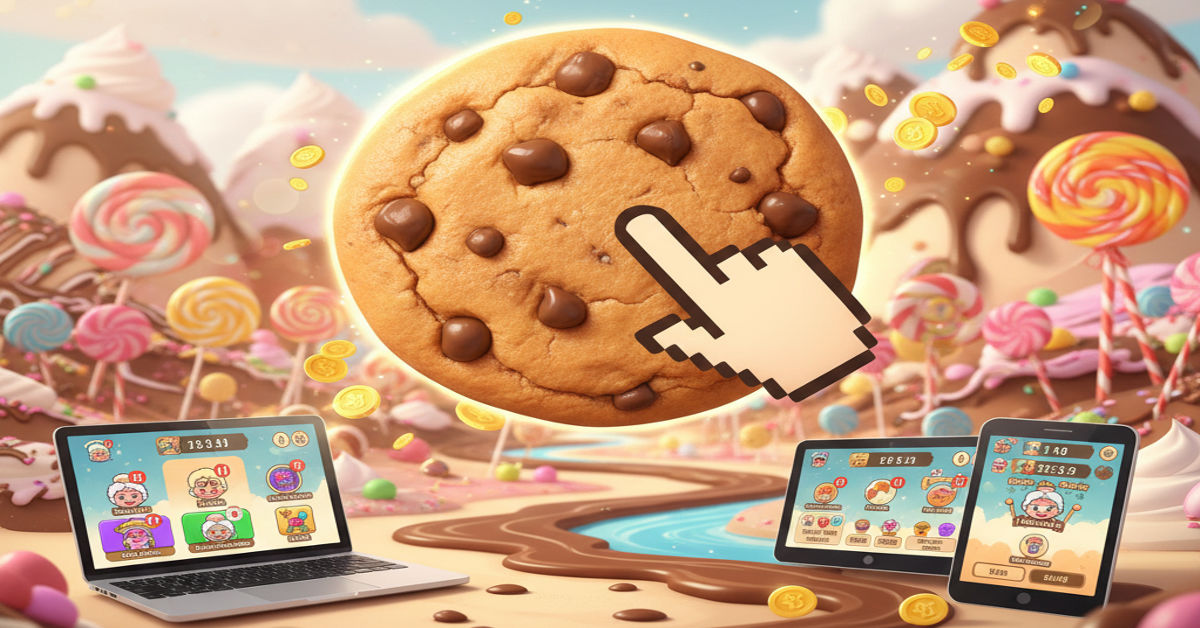
On a quiet afternoon in a school computer lab the most radical act is sometimes the smallest click. Cookie Clicker Unblocked—an accessible version of the famously minimalist idle game—has become a staple of classrooms, offices and restricted networks worldwide. In the first moments of play, it feels almost absurd click a cookie watch a number go up. But behind that simplicity is a sprawling ecosystem of workarounds, educational policy gaps, browser tricks and a deep human fascination with progress measured one tap at a time.
For readers searching to understand what “cookie clicker unblocked” actually means, the answer is straightforward: it refers to ways players access Cookie Clicker on networks that typically block games, often through mirror sites, HTML5 embeds or educational proxies. Yet the phenomenon matters far beyond technical circumvention. Within the first hundred clicks, Cookie Clicker reveals why idle games thrive in restricted environments—why they are hard to detect, easy to justify and surprisingly meaningful to players navigating boredom and control.
Released in 2013 by French programmer Julien “Orteil” Thiennot, Cookie Clicker quickly escaped the confines of novelty. It became a meme, a study in exponential growth, and eventually a quiet rebellion against locked-down digital spaces. As schools tightened firewalls and workplaces monitored productivity software, Cookie Clicker Unblocked flourished—not loudly, but persistently. This article explores how that happened, what it says about digital culture, and why a single cookie still matters more than it should.
The Origins of Cookie Clicker and Its Accidental Longevity
Cookie Clicker launched publicly on August 8, 2013 as a browser-based experiment hosted on Orteil’s personal site. Its mechanics were intentionally bare click to produce cookies, spend cookies to automate production repeat forever. What distinguished it from earlier clickers was tone—dark humor, escalating absurdity, and a willingness to parody capitalism itself. Within weeks, it spread across Reddit and Tumblr, then mainstream tech press.
The game’s endurance is unusual. Many browser games fade with platform shifts, but Cookie Clicker adapted. It survived the decline of Flash by moving to pure JavaScript and HTML5, enabling it to run smoothly inside most modern browsers without plugins. That technical choice would later prove critical. As network filters often target file types, domains, or executable behavior, Cookie Clicker’s lightweight structure made it harder to flag automatically.
Game scholar Jesper Juul once wrote that idle games “externalize patience as a measurable resource,” allowing players to feel progress even when disengaged (Juul, 2019). Cookie Clicker embodied this idea early. You could stop clicking and still advance. In restricted settings, that mattered: the game could run in a background tab, masquerading as harmless code.
Over time, Cookie Clicker evolved with updates, seasonal events, and a Steam release in 2021. Yet the “unblocked” versions—often frozen snapshots or mirrors—remained popular precisely because they were simple, static, and difficult to police.
What “Unblocked” Really Means in Digital Environments
“Unblocked” does not mean illegal. It typically describes content that bypasses institutional restrictions without breaching copyright or security in a traditional sense. Schools and workplaces rely on domain blacklists, keyword scanning, and category-based filtering. Cookie Clicker Unblocked sites exploit gaps in those systems.
Some mirrors host the game under innocuous URLs labeled as “math tools” or “HTML demos.” Others embed the open-source version of the game within platforms like GitHub Pages, which are often whitelisted for educational use. Because Cookie Clicker’s code is client-side and transparent, it can be copied and hosted easily without malware risk—though quality varies.
Below is a simplified comparison of common access methods:
| Access Method | How It Works | Why It Evades Filters | Common Risks |
| Mirror Sites | Clone of original game | New domains not yet blocked | Outdated versions |
| GitHub Pages | Hosted as code demo | GitHub often whitelisted | Inconsistent updates |
| HTML5 Embeds | Embedded in other sites | Appears as generic script | Performance limits |
| Local Files | Saved HTML file | No internet access needed | Manual setup |
Network administrators acknowledge the challenge. “Filtering systems are designed for scale, not nuance,” said Devorah Heitner, author of Screenwise, in a 2020 interview. “Small, text-based games slip through because they don’t look like games at all” (Heitner, 2020).
Idle Games, Boredom and the Psychology of Small Wins
Cookie Clicker Unblocked thrives where attention is fragmented. Idle games reward intermittent engagement, aligning perfectly with environments where full immersion is discouraged or impossible. Psychologists often describe this as “ambient play”—activity that coexists with other obligations.
Dr. Natasha Dow Schüll, whose research on compulsive systems extends from slot machines to digital platforms, has noted that incremental reward loops create a sense of control within constrained settings (Schüll, 2012). Cookie Clicker offers control without confrontation. You are not defying authority openly; you are simply clicking.
The game’s humor reinforces this. As production scales into the billions, descriptions turn sinister: factories, portals, and eldritch beings produce cookies beyond human comprehension. The satire resonates with students trapped in regimented schedules or workers navigating monotonous tasks. Progress becomes ironic, then existential.
Importantly, Cookie Clicker does not demand constant attention. This distinguishes it from blocked multiplayer or action games. You can justify it as a “numbers experiment” or “coding curiosity,” blurring lines between play and productivity.
Educational Spaces and the Quiet Arms Race
Schools have become the primary arena for Cookie Clicker Unblocked. As one of the most searched “unblocked games” terms globally, it reflects a cat-and-mouse dynamic between students and administrators. Filters update; mirrors migrate.
The table below outlines a typical escalation timeline observed in U.S. middle and high schools:
| Year | School Policy Shift | Student Response |
| 2014 | Block Flash games | HTML5 browser games rise |
| 2016 | Domain-based filtering | Mirror sites proliferate |
| 2019 | Category AI filtering | GitHub-hosted games |
| 2022 | Device-level monitoring | Local file versions |
Educational technologist Audrey Watters has criticized over-filtering, arguing that “when schools lock down the web, they teach compliance, not literacy” (Watters, 2018). Cookie Clicker Unblocked becomes a lesson in systems thinking: how networks work, how rules are enforced, and how creativity finds cracks.
Some teachers quietly tolerate it. Anecdotally, Cookie Clicker has been used to explain exponential growth, opportunity cost, and even basic programming logic. Its interface is a spreadsheet in disguise.
Legal, Ethical and Technical Boundaries
Despite the word “unblocked,” most versions of Cookie Clicker operate in a legal gray zone rather than outright illegality. The original game is free to play, and Orteil has historically allowed non-commercial sharing of the code. Problems arise when mirror sites monetize through ads or bundle trackers.
From an ethical standpoint, bypassing filters violates acceptable use policies, though enforcement varies. The low-stakes nature of Cookie Clicker often leads to selective tolerance. It does not enable cheating, harassment, or data extraction. It wastes time—but so does any idle activity.
Technically, users should be cautious. Not all unblocked sites are equal. Security experts warn that some clone pages inject scripts unrelated to gameplay. Running the game offline or via reputable code repositories minimizes risk.
Why Cookie Clicker Endures When Others Fade
Many unblocked games spike and vanish. Cookie Clicker persists because it scales with time, not novelty. You can leave for months and return to astronomical numbers. That persistence mirrors the structures students and workers inhabit: slow accumulation, delayed reward.
Game designer Rami Ismail has argued that Cookie Clicker “made visible the invisible math of games,” stripping systems to their core (Ismail, 2016). Once you understand it, you cannot unsee it—in games, in productivity apps, in metrics-driven life.
The “unblocked” label adds a layer of meaning. Accessing the game becomes part of the experience, a minor victory against constraint. In an era of surveillance software and locked-down devices, that matters.
Takeaways
- Cookie Clicker Unblocked refers to accessible versions that bypass institutional filters, not inherently illegal copies.
- Its HTML5, client-side design makes it difficult for automated systems to detect.
- Idle mechanics suit restricted environments by rewarding minimal, intermittent engagement.
- The game’s satire resonates with users navigating controlled, repetitive systems.
- Over-filtering in schools unintentionally encourages technical workaround literacy.
- Security varies widely among mirror sites; reputable sources matter.
Conclusion
Cookie Clicker Unblocked is not just a game slipping through firewalls. It is a case study in how digital culture adapts to constraint. A single cookie clicked in defiance—or boredom—connects to larger questions about autonomy, attention, and the architectures that shape both. The game’s endurance suggests that when systems prioritize control over curiosity, users will find quieter, cleverer ways to play.
There is something fitting about Cookie Clicker’s lack of an ending. It reflects environments where progress is constant but resolution is absent. In classrooms and offices alike, the game runs in the background, numbers climbing, time passing. Administrators may eventually block every mirror. They may lock down every port. But the impulse remains: to click, to see growth, to claim a small space of agency.
In that sense, Cookie Clicker Unblocked is less about cookies than about cracks in systems—and the human habit of finding them.
FAQs
What is Cookie Clicker Unblocked?
It refers to versions of Cookie Clicker accessible on restricted networks, often via mirror sites or embedded HTML5 files.
Is playing unblocked versions illegal?
Generally no, but it may violate school or workplace acceptable use policies.
Why is Cookie Clicker hard to block?
Its simple, client-side HTML5 structure does not trigger many automated filters.
Are unblocked sites safe?
Some are, some are not. Reputable code-hosting platforms are safer than ad-heavy mirrors.
Can Cookie Clicker be educational?
Yes. It illustrates exponential growth, resource management, and system design concepts.
References
Ismail, R. (2016). The elegance of idle games. Gamasutra. https://www.gamedeveloper.com
Thiennot, J. (2013). Cookie Clicker [Video game]. Orteil. https://orteil.dashnet.org/cookieclicker/