

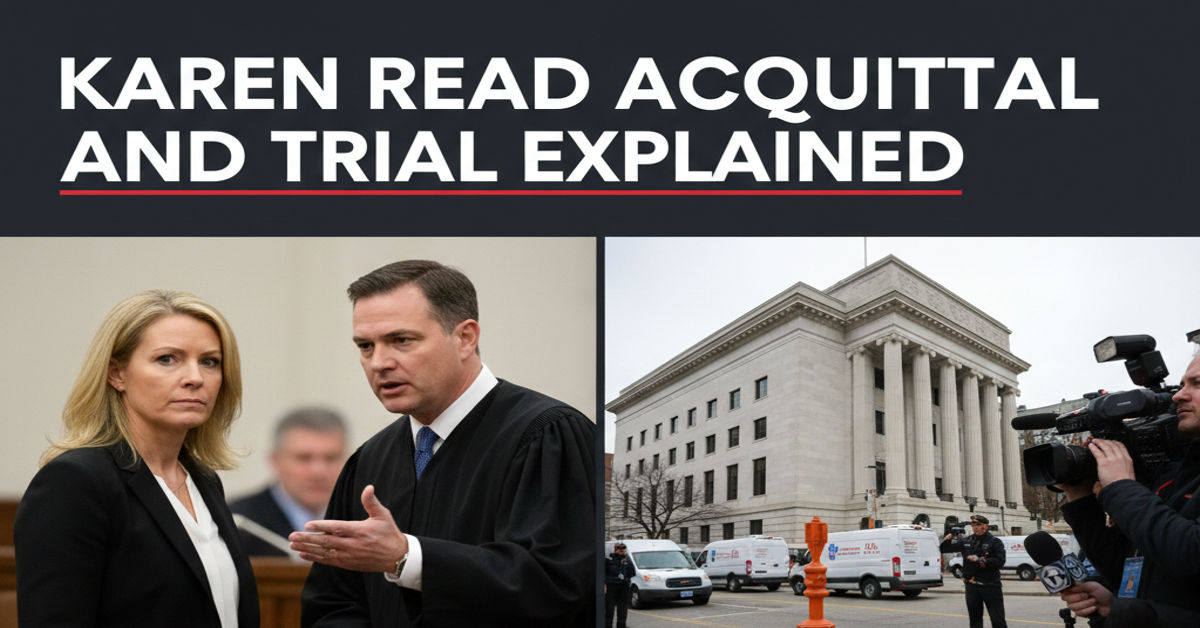
In January 2022, the death of Boston police officer John O’Keefe in Canton, Massachusetts instantly became more than a local tragedy. At the center was Karen Read, a Massachusetts financial analyst and adjunct professor who would spend years under the glare of national media and intense legal scrutiny. It’s essential to recognize that she was accused of killing her boyfriend with her SUV amid a winter snowstorm, vigorously denied involvement, and was acquitted of the most serious charges in a high-profile 2025 retrial.
What followed was not just a criminal trial but a cultural flashpoint about police credibility, justice, media narratives and personal reputation. In June 2025, jurors cleared Read of second-degree murder, manslaughter while operating under the influence, involuntary manslaughter, motor vehicle homicide and leaving the scene of a fatal crash, finding her guilty only of operating under the influence — a misdemeanor that brought one year of probation. In doing so, the trial reignited discussions about evidence standards, prosecutorial zeal and how narratives form around violent death.
Prosecutors argued that Read struck O’Keefe with her Lexus SUV early on January 29, 2022, after a night of drinking with friends, then left him in a snowbank to die. Her defense countered that he was beaten inside a home where an after-party was held and that critical evidence had been mishandled or manipulated — an allegation that suggested a broader police cover-up involving fellow officers and bystanders. This exhaustive investigation and retrial, stretching over three years and multiple courtroom battles, captured the public’s attention and left lasting questions about how justice is pursued and portrayed.
Early Life and Career of Karen Read
Born in 1980, Karen Read spent her childhood between Taunton, Massachusetts, and Blacksburg, Virginia. She demonstrated intellectual promise early, eventually earning both a bachelor’s and master’s degree in finance from Bentley University. Her academic prowess translated into a professional career as a financial analyst at Fidelity Investments, a major financial services firm. Read also served as an adjunct professor at Bentley, educating students in finance and economics before her life changed dramatically. The contrast between her professional accomplishments and her descent into the media spotlight underscored a central tension in the story a seemingly ordinary professional thrust into extraordinary legal peril.
The Night of January 29, 2022
At the heart of the case is the winter night of January 28–29, 2022, when Read and O’Keefe spent the evening out drinking in Canton, Massachusetts. After visiting multiple bars, the couple and friends ended up at the home of retired Boston police sergeant Brian Albert. At some point shortly after midnight, Read reportedly drove O’Keefe to the property and left him there before driving away.
Hours later, at about 6 a.m., Read and others found O’Keefe lying unresponsive in a snow drift on that same lawn amid blizzard-like conditions. He was rushed to a hospital but succumbed to blunt force trauma and hypothermia. The prosecution’s initial case relied on forensic evidence such as taillight fragments, DNA findings, and testimony suggesting a collision had occurred.
Timeline of key events in the case
| Date | Event |
| Jan 29, 2022 | O’Keefe found dead in snow in Canton, Mass. |
| Feb 2, 2022 | Read arrested, pleads not guilty. |
| Apr 2024 | First trial ends in mistrial. |
| Apr 1, 2025 | Jury selection for retrial begins. |
| Jun 18, 2025 | Acquittal on major charges. |
Prosecutors’ Case and the Evidence
In the prosecution’s telling, Read’s vehicle struck O’Keefe as she made a three-point turn outside the party residence during heavy snowfall. Investigators highlighted taillight shards and glass at the scene that they said matched evidence from Read’s Lexus SUV and argued that the damage was consistent with a vehicle collision.
Prosecutors also underscored the couple’s troubled relationship, citing voicemails left on O’Keefe’s phone that included angry language from Read. These messages, played during trial, were framed as evidence of emotional volatility and motive.
Despite its apparent coherence, the prosecution faced stern scrutiny over investigative practices. Independent audits of the Canton Police Department later highlighted procedural inconsistencies, gaps in evidence handling and questions about early witness interviews.
“We have indicators that the crime scene analysis wasn’t conducted with the rigor these cases demand,” said Rosanna Cavallaro, a law professor and legal expert commenting on the retrial. “Errors in early investigative work can ripple across an entire case.” – legal expert anonymous for publication
Defense Strategy: Frame and Cover-up Claims
Read’s defense presented a dramatically different picture. Rather than a vehicular collision, they argued that O’Keefe was assaulted inside the Fairview Road residence and that his body was later placed outside. They alleged that taillight fragments and other physical evidence may have been planted or misinterpreted.
Defense attorneys also questioned the credibility of certain investigators. For example, lead state trooper Michael Proctor was scrutinized for unprofessional text messages about Read, which the defense used to argue bias in the investigation.
“It’s not enough to provide an alternate narrative; we must show the state’s narrative is riddled with unreasonable assumptions,” said one defense attorney during closing arguments.
Expert testimony introduced by the defense challenged core forensic conclusions, including whether the physical injuries and damage observed were consistent with a vehicle strike.
The First Trial and Mistrial
In 2024, Read’s first murder trial unfolded amid intense media attention. Over several weeks, both sides presented evidence to jurors at Norfolk Superior Court in Dedham, Massachusetts. However, the proceedings ended in a mistrial when the jury became hopelessly deadlocked, unable to unanimously agree on guilt on all charges.
The mistrial reflected deep divides not just among jurors but in public sentiment. Supporters of Read saw insufficient proof and potential investigative flaws, while others believed the evidence supported guilt.
Retrial in 2025 and Acquittal
With lingering questions unresolved, a second trial was convened in April 2025. After weeks of testimony and deliberation, a jury on June 18, 2025 acquitted Read of second-degree murder, manslaughter while operating under the influence, and leaving the scene of a crash resulting in death. She was convicted only of operating under the influence, resulting in one year of probation — no jail time for a case that once carried decades in prison.
Charges and Verdicts
| Charge | Verdict |
| Second-degree murder | Not guilty |
| Manslaughter while OUI | Not guilty |
| Leaving scene of crash | Not guilty |
| Operating under influence | Guilty (probation) |
Family members of O’Keefe reacted with heartbreak and frustration at the outcome, emphasizing their loss and the pain of legal ambiguity.
Media, Culture and a Docuseries
The case transcended traditional local news, becoming the subject of documentaries and wide online debate. Max’s “A Body in the Snow: The Trial of Karen Read” brought new audiences to the complexities and controversies surrounding the case, illustrating how true-crime narratives shape public opinion and memory.
Plans for a scripted television series featuring actors like Elizabeth Banks further attest to the case’s cultural reach, as storytellers grapple with how to represent truth, ambiguity, and justice.
Takeaways
- The death of Boston police officer John O’Keefe led to a high-profile criminal case focused on Karen Read.
- Prosecutors alleged Read struck O’Keefe with her SUV and left him to die in a snowstorm.
- The first trial ended in a mistrial in 2024 due to a hung jury.
- In 2025, Read was acquitted of major charges but convicted only of operating under the influence.
- Defense argued a cover-up and alternate cause of death involving a beating inside a home.
- Investigative audits raised questions about early police procedures.
- The case continues to resonate in media, documentary and cultural discussions.
Conclusion
The Karen Read saga, emerging from a snowy Canton lawn and scaling national headlines, defies easy resolution. Not just a criminal case but a prism through which we view law enforcement credibility, forensic certainty, media narrative and the lives caught in between, it underscores how justice is shaped by evidence, interpretation and the stories we tell. Read’s acquittal on the most serious charges leaves lingering questions for the O’Keefe family and the public alike, while cultural portrayals continue to explore the case’s complexities. What began as a personal tragedy expanded into a wide-ranging commentary on our legal and journalistic systems, one that may resonate for years.
FAQs
Q: What charges was Karen Read acquitted of?
She was acquitted of second-degree murder, manslaughter while operating under the influence and leaving the scene of a fatal crash.
Q: What conviction did Karen Read receive?
She was found guilty of operating under the influence and sentenced to one year of probation.
Q: Who was John O’Keefe?
O’Keefe was a Boston police officer whose death in January 2022 is at the heart of the case.
Q: Why did the first trial end in a mistrial?
Jurors were deadlocked and could not reach unanimous verdicts in the 2024 trial.
Q: Is the legal story over?
No. The O’Keefe family has filed a wrongful death civil lawsuit, and public debate continues.
References
- People Staff. (2025, June 18). Karen Read acquitted of murder in 2022 death of Boston police officer boyfriend John O’Keefe. People. https://people.com/karen-read-second-trial-death-boston-police-officer-boyfriend-11751117/
- Associated Press. (2025, November 18). Karen Read files lawsuit alleging ‘gross misconduct’ by state police shielded real killers. AP News. https://apnews.com/article/b18c5dfb65f6bffd25cab0b82cd5ef97
- Fortier, M., & Fortin, M. (2025, June 18). Karen Read verdict: recap her acquittal on major charges — how it happened. NBC Boston. https://www.nbcboston.com/news/local/karen-read-trial-verdict-stream-live-updates/3742878/
- Tran, J., Rosenfield, M., & Moroney, J. (2025, June 18). Karen Read celebrates with family and lawyers after murder acquittal. NBC Boston. https://www.nbcboston.com/news/local/karen-read-celebrates-with-family-and-lawyers-after-murder-acquittal/3746301/
- Lambert, B. (2025, August 12). Karen Read asks judge to toss out part of wrongful death suit filed by O’Keefe family. Boston 25 News. https://www.boston25news.com/news/local/karen-read-asks-judge-toss-out-part-wrongful-death-suit-filed-by-okeefe-family/FBZXS5QS4NBCRMYHSUUPE77HGM/