

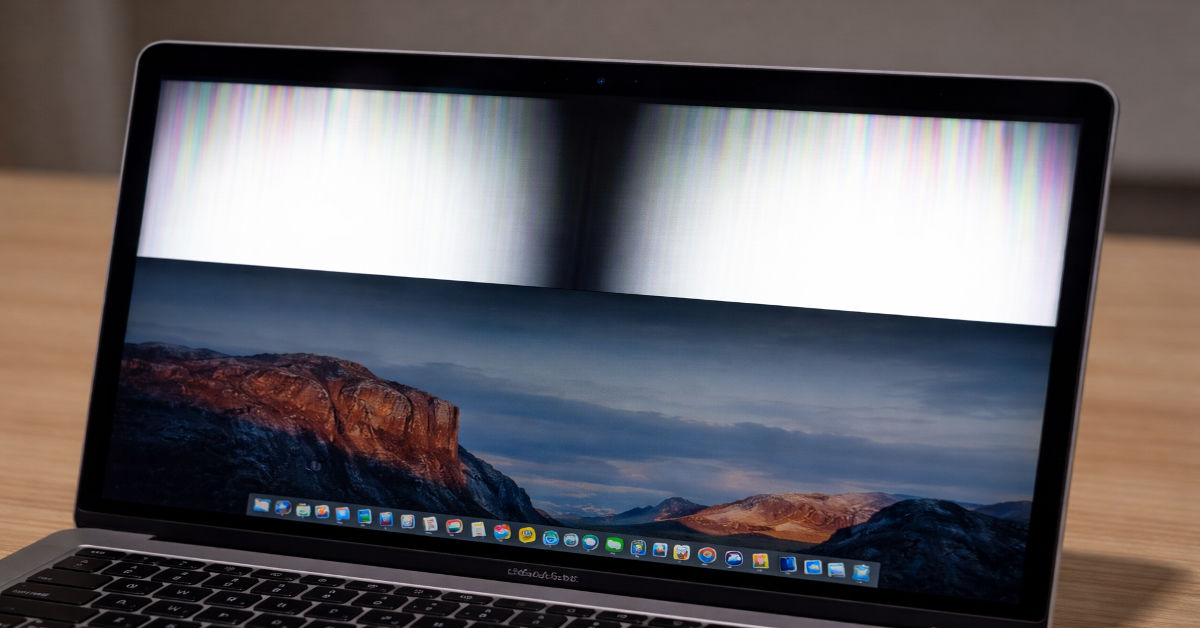
For owners of Apple’s redesigned MacBook Pro released in late 2016 the dreaded term Flexgate became a reality over time. First spotted in online discussions in 2018 and early 2019 users began reporting unusual display behavior that worsened with normal lid movement. The defect manifested as uneven backlight illumination near the bottom of the screen often dubbed the “stage light” effect and at worst complete loss of display backlight when the screen was opened beyond certain angles. Apple’s premium laptop had developed a design flaw hidden in one of its most fundamental mechanical interactions of opening and closing the display lid.
At the core of the problem was a ribbon‑style flexible cable that connected the display assembly to the logic board beneath the top case. Unlike previous MacBook Pros that used wiring routed through the hinge, the 2016 models introduced a flex cable wrapped around the hinge that experienced increasing tension with repeated use. With daily opening and closing over months and years the thin cable would wear at the stress point and eventually fail. When that happened the backlight system could stop functioning or behave erratically even while the rest of the laptop continued running normally.
How Flexgate emerged in the MacBook Pro line
When Apple debuted the 2016 MacBook Pro it marked a massive hardware redesign. The laptop was thinner featured Touch Bar options and shifted many internal components to new locations. In doing so the display cable had to stretch farther around the hinge than in past models and was engineered as a flexible printed strip rather than more robust wire. Early on this did not pose immediate problems. But over time owners began noticing screen anomalies that tracked with repeated lid motion and appeared universally on certain 2016 and early 2017 models.
Independent teardown reports from repair specialists highlighted the root cause. The flex cable was loosely wrapped around a small circuit board inside the display housing and was pulled taut each time the lid was opened. Normal user behavior like lifting the laptop by one corner or opening it with one hand increased this repeated stress on a cable that lacked sufficient slack. As the cable fibers fatigued microscopic tears grew until electrical continuity in the backlight circuit was lost.
What symptoms owners saw first
Owners and technicians identified a predictable set of symptoms as the Flexgate defect advanced:
- A visible bright band or uneven brightness at the bottom of the display often compared to stage lighting.
- Flickering or distortion that changed with the angle of the screen.
- Complete loss of backlight while the machine still worked with an external display.
- Progressive failure over months and years of normal use.
The defect was frustrating because the rest of the device often functioned perfectly even as the display went dark. Many reports noted that opening the screen only a few degrees could restore visibility temporarily only for the failure to return.
Apple’s response and the repair program
Apple’s official response was measured. In May 2019 the company launched a Backlight Repair Program for 13‑inch MacBook Pro models manufactured in 2016. Under the program Apple agreed to repair affected displays free of charge for eligible devices sold between October 2016 and February 2018 that exhibited the described issue. Notably this coverage was extended later to cover up to five years after the original purchase date for eligible units.
However this repair program did not initially include 15‑inch models nor some later variants beyond the original 13‑inch 2016 machines. That left many owners of 15‑inch laptops and later 2017 models on their own with effective repair costs running into several hundred dollars if they were out of warranty. In many repair centers because the flex cable is integrated into the LCD assembly the only practical way to fix it was complete screen replacement.
The design change in later MacBook Pros
By 2018 Apple appeared to address the root mechanical stress of the problem. Teardowns and reports indicated that the display flex cable in 2018 MacBook Pros was manufactured slightly longer and with a configuration that reduced tension during lid opening. The marginal increase in length was intended to give the cable slack so it was less prone to fatigue. While this change did not absolutely eliminate all potential display cable wear in future generations it significantly reduced the incidence of the earlier failure mode.
A quick reference comparison
| Model Year | Flexgate Susceptible | Official Repair Program | Cable Revision |
| 2016 13″ | Yes | Yes (Backlight Program) | Original short cable |
| 2016 15″ | Yes | No or limited | Original short cable |
| 2017 | Yes | Limited | Original design |
| 2018+ | Reduced incidence | Not needed broadly | Longer flex cable |
What owners should know now
Flexgate remains a cautionary chapter in the history of Apple’s hardware design. While Apple’s later revisions have mitigated the problem it highlights how a minor cable routed incorrectly can undermine the long‑term reliability of an otherwise premium laptop. If you own a 2016 MacBook Pro and your machine starts showing backlight issues consider these steps:
- Check your eligibility for Apple’s backlight repair program.
- Before paying for full display replacement seek diagnosis from an authorized technician.
- Ask whether the issue is truly backlight cable related and whether a partial fix is possible.
In many cases you may find repair centers or specialists who can splice or extend the cable at lower cost than full display replacement though results vary.
Takeaways
- Flexgate is a hardware design defect in 2016 MacBook Pros affecting the display backlight.
- The root cause was a flex cable that wore out due to repeated lid motion.
- Apple’s repair program covered some 13‑inch models but not all affected laptops.
- Later MacBook Pro models use a revised cable to reduce the problem.
- Repair costs remain significant if out of warranty.
Conclusion
The Flexgate episode underlines a broader truth in modern computer design: engineering decisions that save space or weight can introduce new long‑term failure modes. For users it translated into the irony of a device meant to last years becoming compromised by a small part stressed by everyday movements. Apple’s eventual partial repair program acknowledged the design flaw while reinforcing the importance of careful routing and component longevity in ultra‑thin laptops. Even today understanding Flexgate helps users make informed decisions about Flexgate MacBook Pro 2016 device maintenance and repair options.
FAQs
1. What is Flexgate on the MacBook Pro 2016?
Flexgate is a hardware defect where the display’s thin flex cable frays over time, causing backlight failure, flickering, or distortion.
2. Which models are affected?
Primarily the 13‑inch (A1706, A1708) and 15‑inch (A1707) MacBook Pro models from 2016–2018.
3. Is Flexgate still covered by Apple in 2026?
Most official repair programs for 2016 models have expired, though some units may qualify if purchased late or extended coverage applies.
4. How much does it cost to fix?
Third-party repairs range from $300–$700, often requiring a full display replacement; Apple repairs cost more if out of warranty.
5. Can a 2018 MacBook Pro screen replace a 2016 one?
No. Cable designs and display connectors differ, so 2018 screens are not directly compatible with 2016 models.