

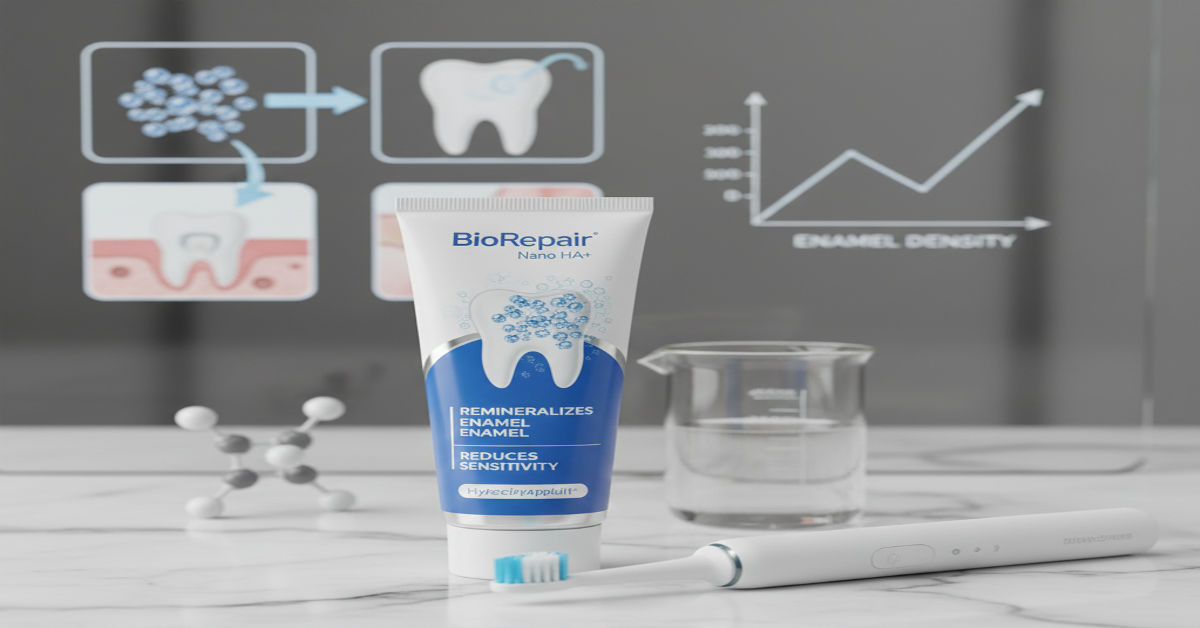
Hydroxyapatite toothpaste has emerged as an innovative option in oral health, offering a biomimetic approach to enamel protection. Within the first few brush strokes, hydroxyapatite—a naturally occurring mineral in teeth—works to fill microscopic defects, remineralize enamel and reduce sensitivity. Unlike fluoride, which primarily strengthens enamel through the formation of fluorapatite, hydroxyapatite deposits calcium and phosphate ions directly onto the tooth surface, creating a protective layer that mirrors the structure of natural enamel.
Originally developed in Japan in the 1970s and approved for anti-cavity use in the 1990s, hydroxyapatite toothpaste has gradually gained attention worldwide. Its appeal lies not only in potential caries prevention but also in its fluoride-free formulation, making it attractive for individuals with sensitivities or those preferring alternative oral care solutions. While research remains ongoing, laboratory and clinical studies suggest hydroxyapatite can achieve similar remineralization effects to fluoride, offering a promising adjunct in modern oral hygiene routines.
As consumers seek safer, scientifically grounded alternatives, hydroxyapatite toothpaste is gaining recognition for its multifaceted benefits, including enamel strengthening, sensitivity reduction, and mild whitening. This article examines the science, research, expert insights, and practical considerations surrounding hydroxyapatite toothpaste.
The Science of Hydroxyapatite
Hydroxyapatite (Ca₅(PO₄)₃(OH)) is the primary mineral component of tooth enamel and bone. Its structure closely resembles natural enamel crystals, which allows synthetic hydroxyapatite to bond effectively with teeth when incorporated into toothpaste. The particles attach to the enamel surface, filling microdefects and promoting remineralization.
Demineralization occurs when acids from bacteria and foods dissolve enamel minerals, creating vulnerabilities to cavities. Fluoride strengthens enamel by forming fluorapatite, which resists acid attack. Hydroxyapatite takes a complementary approach, replenishing calcium and phosphate directly. Studies indicate that hydroxyapatite can achieve comparable results to fluoride in certain clinical contexts, making it a viable option for those seeking fluoride-free oral care.
Beyond remineralization, hydroxyapatite toothpaste has been observed to reduce sensitivity by blocking exposed dentin tubules and may impart a subtle whitening effect due to its reflective mineral particles.
Hydroxyapatite vs. Fluoride: A Comparison
| Feature | Hydroxyapatite Toothpaste | Fluoride Toothpaste |
| Caries prevention | Comparable in some studies | Well-established and extensively studied |
| Remineralization mechanism | Deposits calcium/phosphate, repairs microdefects | Forms fluorapatite, enhances enamel resilience |
| Regulatory approval (U.S.) | Not FDA-approved for anti-cavity claims | ADA Seal of Acceptance common |
| Sensitivity relief | Can reduce sensitivity by occluding dentin tubules | Often includes desensitizing agents |
| Typical concentration | 5–10% hydroxyapatite | 1000–1500 ppm fluoride |
Research and Clinical Evidence
Hydroxyapatite toothpaste has been studied in vitro, in situ, and in clinical trials. A key 2019 study demonstrated that hydroxyapatite could form a mineral layer on enamel surfaces and protect against early lesions in children’s teeth. Systematic reviews suggest hydroxyapatite toothpaste can prevent caries progression and support remineralization with similar efficacy to fluoride, while being highly biocompatible.
Research also explores modified hydroxyapatite with additional ions, such as zinc or silicon, which may enhance mineralization without causing irritation. Despite promising findings, long-term, large-scale clinical trials remain limited, and further research is needed to fully establish hydroxyapatite’s efficacy relative to traditional fluoride toothpaste.
Expert Perspectives
“Hydroxyapatite adds a protective layer on the surface of the tooth, particularly in areas of dental erosion. When acids attack, they attack the hydroxyapatite layer first, protecting natural enamel.” — Bennett Amaechi, PhD, University of Texas at San Antonio
Experts emphasize that while fluoride remains the most studied and proven anti-caries agent, hydroxyapatite provides a scientifically valid alternative, particularly for individuals who avoid fluoride or have sensitive enamel.
Timeline of Hydroxyapatite Toothpaste Development
| Era | Milestone |
| 1970s | NASA licenses synthetic hydroxyapatite technology |
| Early 1990s | Japan approves hydroxyapatite toothpaste for anti-cavity use |
| 2000s | Nano-hydroxyapatite formulations developed |
| 2019 | Clinical studies show enamel remineralization and protection |
| 2025 | Systematic reviews support comparable caries prevention to fluoride |
Practical Considerations
Hydroxyapatite toothpaste is not yet FDA-approved in the U.S. for anti-cavity claims, though it is considered safe for general use. Concentrations vary among brands, with research suggesting optimal results at around 10%. The toothpaste may be slightly more expensive than conventional fluoride options, but it provides benefits such as reduced sensitivity and mild whitening. Dental professionals recommend using hydroxyapatite toothpaste as part of a broader oral hygiene routine, rather than a standalone solution, particularly for high-risk patients.
Takeaways
- Hydroxyapatite toothpaste mimics natural enamel, promoting remineralization and enamel strengthening.
- Clinical studies suggest comparable caries prevention to fluoride in specific contexts.
- Not FDA-approved for anti-cavity claims in the U.S.; further long-term studies are needed.
- It can reduce sensitivity and may provide mild whitening effects.
- Brand formulations vary in hydroxyapatite concentration and cost.
- Recommended as part of comprehensive oral care, not a replacement for professional dental care.
- Suitable for fluoride-free preferences or sensitive enamel individuals.
Conclusion
Hydroxyapatite toothpast’e represents a significant shift in oral care, emphasizing biomimicry and enamel restoration. Clinical evidence shows it can promote remineralization, reduce sensitivity, and prevent caries in some populations, although large-scale, long-term trials remain limited. While fluoride remains the standard for cavity prevention, hydroxyapatite provides a scientifically grounded alternative, especially for those seeking fluoride-free solutions. As research continues, hydroxyapatite toothpaste may gain wider adoption and regulatory recognition, offering consumers an innovative tool in maintaining oral health.
FAQs
What is hydroxyapatite toothpaste?
It contains synthetic enamel-like minerals to strengthen teeth, promote remineralization, and reduce sensitivity.
Is hydroxyapatite as effective as fluoride?
Studies suggest comparable results in enamel remineralization and caries prevention under certain conditions.
Is hydroxyapatite toothpaste safe?
Yes, it is considered biocompatible and safe for regular use.
Can it reduce tooth sensitivity?
Yes, hydroxyapatite can help occlude exposed dentin tubules, reducing sensitivity.
Should I switch from fluoride toothpaste?
Consult a dentist hydroxyapatite can be an alternative, but fluoride remains highly effective.
References
Amaechi, B. T. (n.d.). Hydroxyapatite Toothpaste: Benefits and Safety Considerations. WebMD. Retrieved December 2025, from https://www.webmd.com/oral-health/hydroxyapatite-toothpaste WebMD
Enamel remineralization and repair results of Biomimetic Hydroxyapatite toothpaste on deciduous teeth: an effective option to fluoride toothpaste. (2019). Journal of Nanobiotechnology, 17, Article 17. https://jnanobiotechnology.biomedcentral.com/articles/10.1186/s12951-019-0454-6 SpringerLink
Healthline. (n.d.). How Hydroxyapatite Toothpaste Helps Tooth Remineralization. Retrieved December 2025, from https://www.healthline.com/health/dental-and-oral-health/hydroxyapatite-toothpaste Healthline
Schlagenhauf, U., Lennon, Á. M., & Declerck, D. (2025). The role of hydroxyapatite‑based, fluoride‑free toothpastes on the prevention and remineralization of initial caries lesions: A systematic review and meta‑analysis. PubMed. https://pubmed.ncbi.nlm.nih.gov/40107597/ PubMed
Comparative efficacy of a hydroxyapatite and a fluoride toothpaste for prevention and remineralization of dental caries in children. (2019). PubMed. https://pubmed.ncbi.nlm.nih.gov/31839988/ PubMed