

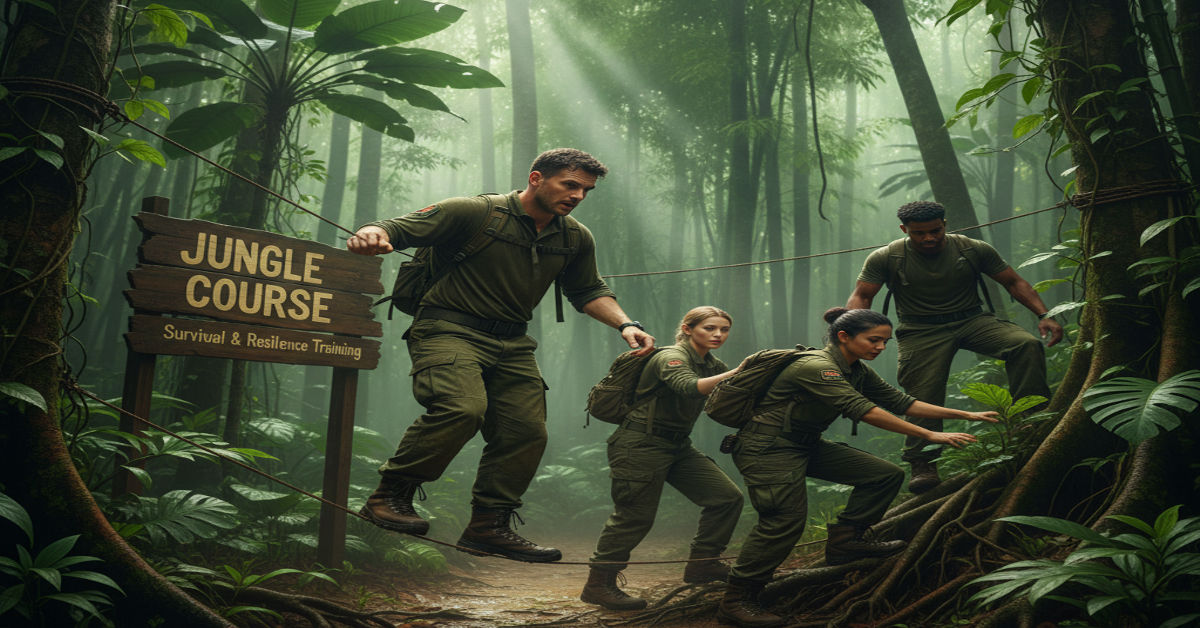
The Jungle Confidence Course (JCC) stands as one of the most intense physical and psychological trials outside actual combat. At its core, the course is designed to push participants beyond perceived limits, teaching survival skills and resilience in some of the planet’s harshest environments. Unlike conventional obstacle courses, the JCC immerses candidates in dense, often unforgiving jungles, where navigation, rationing and adaptability become matters of survival.
Military forces have long recognized the jungle as a proving ground. In Singapore, for example, officer cadets are deployed to Brunei’s rugged rainforest for nine days with minimal rations, testing not only their physical endurance but also leadership, teamwork, and mental fortitude. Such experiences cultivate what military instructors call “jungle-tested” confidence — the capacity to face uncertainty, stress and fatigue while maintaining clarity of purpose.
Beyond the military, the JCC has inspired civilian leadership programs and corporate resilience exercises, reflecting a broader fascination with immersive, extreme experiences as tools for personal transformation. Whether navigating rain-soaked trails, constructing emergency shelters, or managing group dynamics under duress, participants report profound changes in self-awareness, discipline, and confidence. The Jungle Confidence Course, both ancient in concept and continually evolving, remains a crucible for physical skill, mental resilience, and personal growth.
Origins and Purpose of Jungle Confidence Training
The practice of using jungles as a training environment has deep historical roots. Military institutions across the globe, from the British Army to the U.S. Army, have long employed dense forests as ideal sites for survival and tactical training. Jungle environments are unpredictable, physically demanding, and psychologically taxing, making them unmatched for developing resilience and adaptability.
In the 1960s, the U.S. Army’s Jungle Operations Course in Panama introduced soldiers to multi-day exercises under extreme tropical conditions, emphasizing navigation, resource management, and endurance. Modern equivalents include France’s Equatorial Forest Training Center and the U.S. Army’s Jungle Operations Training Center in Hawaii. These programs ensure that troops not only survive harsh conditions but also thrive under uncertainty, a skill applicable in diverse operational contexts.
The Jungle Confidence Course differentiates itself from standard military jungle training by emphasizing psychological resilience as much as physical skill. While students learn to find water, build shelter, and navigate challenging terrain, the course is structured to confront participants with fatigue, hunger, isolation, and stress — deliberately pushing them to discover their limits and develop self-confidence. In many forces, jungle proficiency is codified alongside other elite achievements, signaling both operational readiness and personal accomplishment.
Anatomy of a Jungle Confidence Course
At the heart of the JCC lies a rigorous combination of physical, mental, and environmental challenges. Participants navigate steep ridges, dense undergrowth, and unpredictable weather while carrying heavy packs, rationing scarce food, and constructing shelters from raw materials. Constant exposure to rain, humidity, and insects strips away comfort and demands sustained focus and adaptability.
| Course Element | Purpose / Skill Developed |
| Minimal Rations | Teaches hunger management, rationing, and resilience |
| Navigation through Terrain | Builds spatial awareness under stress and uncertainty |
| Shelter Construction | Develops practical survival skills and teamwork under pressure |
| Unpredictable Weather | Enhances adaptability to external stressors |
| Isolation and Group Stress | Reinforces mental resilience, peer trust, and leadership dynamics |
Trainees often describe the experience as transformational. One cadet recalled navigating unmapped ridges and building makeshift shelters while exhausted, wet, and bitten by insects — challenges that forced a heightened sense of self-reliance and trust in team members.
Psychological and Leadership Impact
The JCC is as much a mental crucible as a physical one. Confronted with discomfort, uncertainty, and isolation, participants are forced to examine their limitations and redefine their capabilities. Studies of military training highlight that structured stress environments accelerate leadership development, self-discipline, and problem-solving skills.
Former participants frequently report lasting personal growth. One Singaporean financial professional who completed the course described it as a turning point: “If I can survive the jungle, I can survive anything.” Beyond survival skills, the JCC reinforces leadership, teamwork, and accountability. Officer cadets often cover long distances carrying heavy loads, sharing limited food, and coordinating in challenging conditions, gaining insights into both collective and individual responsibility.
Jungle Training in Modern Military Doctrine
Despite advances in technology and shifts in warfare, jungle training remains a strategic priority. Modern militaries value the transferable skills it develops: navigation under uncertainty, adaptability, problem-solving under stress, and close-quarters maneuvering. The U.S. Army, for instance, emphasizes that skills learned in tropical forests improve operational performance across multiple theaters, from deserts to urban environments.
| Training Institution | Location | Focus |
| British Army Jungle Warfare Training School | Brunei / Malaysia | Operational jungle warfighting |
| Equatorial Forest Training Center (CEFE) | French Guiana | Jungle survival and operations |
| U.S. Army Jungle Operations Training Center | Hawaii, USA | Tactical jungle proficiency |
| Singapore Jungle Confidence Course (JCC) | Brunei | Psychological resilience and survival |
Civilian leadership programs have adapted elements of the JCC to promote teamwork, resilience, and problem-solving in less extreme but still challenging environments. These courses underscore the value of controlled adversity in building confidence and interpersonal skills.
Expert Insights
Dr. Samuel Johnson, Military Historian:
“Training in dense unpredictable environments like jungles forces a synthesis of tactical skill and psychological resilience unmatched elsewhere in military instruction.”
Lt. Col. Maria Torres, Jungle Warfare Instructor:
“The jungle doesn’t care about rank or accolades; only your ability to adapt, learn, and endure matters.”
Captain Elaine Wu, Leadership Consultant:
“Structured adversity, as seen in jungle confidence courses, accelerates self-awareness and team cohesion in ways conventional programs cannot.”
These perspectives highlight the dual purpose of the JCC: developing technical survival skills while cultivating resilience, leadership, and self-confidence.
Key Takeaways
- Jungle Confidence Courses blend survival skills with mental endurance, pushing participants beyond prior limits.
- Military institutions worldwide value jungle training for resilience, adaptability, and operational readiness.
- Core course elements include rationing, navigation, shelter building, and exposure to unpredictable conditions.
- Participants often experience lasting personal transformation, applying lessons far beyond the jungle.
- Skills acquired have practical applications in both military and civilian contexts.
Conclusion
The Jungle Confidence Course is more than a physical challenge it is a deliberate test of character and adaptability. By immersing participants in relentless environments that strip away comfort and certainty, the course forces a confrontation with fear, exhaustion, and self-doubt. In doing so, it cultivates resilience, teamwork, leadership, and a profound sense of personal achievement.
From Brunei’s rainforest to jungle training centers worldwide, the JCC continues to shape soldiers, leaders, and civilians alike. It is a testament to the enduring power of structured adversity — demonstrating that true confidence is forged not in comfort, but in the crucible of challenge.
Frequently Asked Questions
What is a Jungle Confidence Course?
It is an intensive survival and resilience training program conducted in dense jungle environments, designed to develop physical and psychological endurance.
Who typically undergoes the course?
Mostly military personnel and cadets, though some civilian leadership programs incorporate similar elements.
Where are these courses held?
Locations include Brunei, Hawaii, French Guiana, and other remote jungles around the world.
What skills are taught?
Navigation, survival, rationing, shelter construction, teamwork, problem-solving, and stress management.
Is the course only physical?
No — mental resilience and leadership under pressure are core aspects alongside physical challenges.
References
Abbreviation Finder. (n.d.). JCC stands for Jungle Confidence Course. https://www.abbreviationfinder.org/acronyms/jcc_jungle-confidence-course.html Abbreviation Finder
Army.mil. (n.d.). Jungle Operations Training Course challenges mental, physical readiness. https://www.army.mil/article/190264/jungle_operations_training_course_challenges_mental_physical_readiness Army
Defense.gov. (n.d.). Face of Defense: Jungle Operations Course challenges military students. https://www.defense.gov/News/News-Stories/Article/Article/1241104/face-of-defense-jungle-operations-course-challenges-military-students/ U.S. Department of War
LinkedIn. (n.d.). Nomad in Brunei – Tales of Jungle Confidence Course. https://www.linkedin.com/pulse/nomad-brunei-tales-jungle-confidence-course-aayush-garg-rb73c LinkedIn
MustShareNews. (n.d.). Ex-SAF Commando creates jungle courses for kids. https://mustsharenews.com/commando-jungle-courses-kids/ MS News
Singapore Army. (n.d.). Badges | Singapore Army. https://www.army.gov.sg/our-forces/badges/ Singapore Army
Wikipedia. (n.d.). Equatorial Forest Training Center. https://en.wikipedia.org/wiki/Equatorial_Forest_Training_Center Wikipedia