

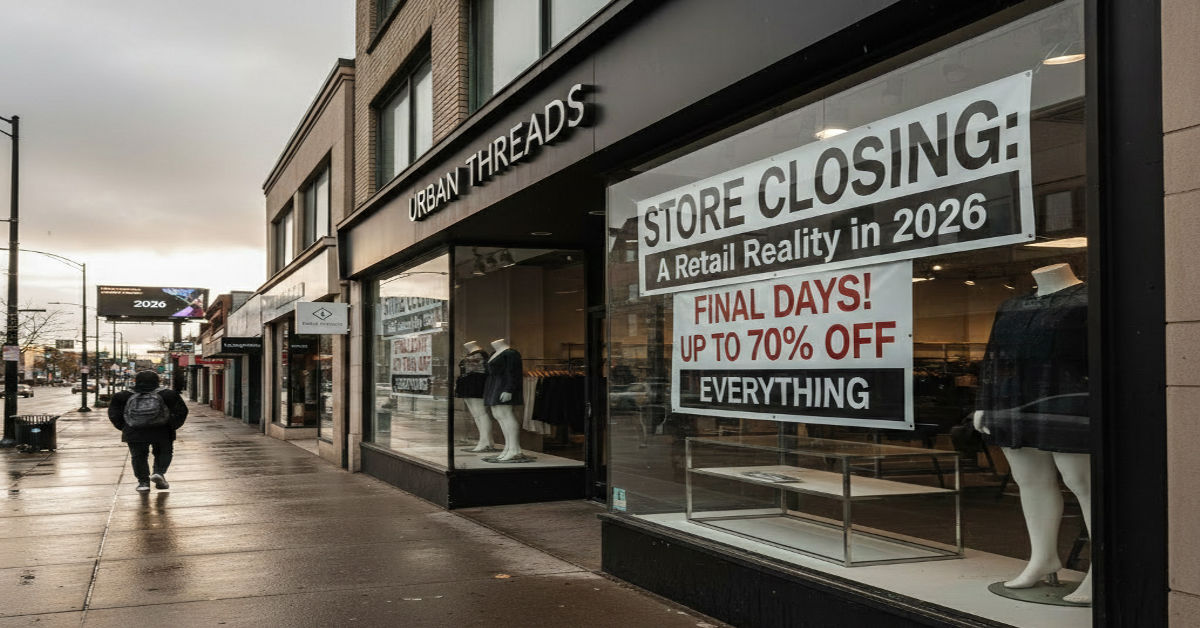
Store closing have become an increasingly common phenomenon in 2026, as retailers across the United Kingdom and the United States respond to changing consumer behaviors, rising costs, and competitive pressures from online shopping. In the UK, Poundland has announced plans to close 12 stores in January and February, offering clearance discounts of up to 40 percent on remaining stock. The closures affect locations such as Bex, Poplar East, and Kilmarnock in Ayrshire, with more planned as leases expire and the chain reduces its store count from 800 to roughly 650–700.
In the United States, major chains including Macy’s, Marshalls, JCPenney, Saks Off 5th and Yankee Candle are following a similar pattern. Macy’s plans to close around 150 stores by the end of the year as part of its “Bold New Chapter” strategy, while Marshalls has already shuttered two California locations. These store closings reflect a broader industry trend: physical locations are being evaluated more critically for profitability, while digital channels and flagship stores take precedence.
For consumers, store closings present both challenges and opportunities. While the loss of local retail outlets affects high street traffic and community access, clearance sales often provide temporary bargains. Understanding the scale, reasons, and impacts of store closings in 2026 provides insight into the evolution of modern retail.
Poundland Store Closing in the UK
Poundland’s store closings in early 2026 highlight the pressures facing discount retailers in the UK. The closures are part of a planned strategy to focus on more profitable locations and reduce operational costs. Key affected stores include Bex, Poplar East, and Kilmarnock, with others following in February. Clearance sales will provide discounts up to 40 percent across a wide range of products, including home goods, groceries, and clothing.
The chain’s overall store count is expected to drop to 650–700 by the end of 2026, down from 800 the previous year. Lease expirations and rent considerations have played a central role in selecting locations for closure. Retail analysts note that such strategic downsizing enables Poundland to strengthen its financial position while streamlining operations in a competitive market.
Poundland Store Closing Timeline
| Store | Location | Closure Date | Discount Offer |
| Bex | East | January 5, 2026 | Up to 40% |
| Poplar East | London | January 5, 2026 | Up to 40% |
| Kilmarnock | Ayrshire | January 5, 2026 | Up to 40% |
| Mitcham | Greater London | January 14, 2026 | Up to 40% |
| Liverpool | Merseyside | January 15, 2026 | Up to 40% |
| Yeovil | Somerset | January 16, 2026 | Up to 40% |
| Christchurch | Dorset | January 23, 2026 | Up to 40% |
| Bristol Avon Meads | Bristol | January 29, 2026 | Up to 40% |
| Coatbridge | Scotland | February 8, 2026 | Up to 40% |
These closures, while difficult for communities, illustrate a broader trend in UK retail: focusing on profitable stores and optimizing operations for long-term sustainability.
U.S. Retail Store Closing: Macy’s, Marshalls, and Beyond
In the United States, store closings in 2026 are reshaping major retail chains. Macy’s is closing underperforming stores as part of its “Bold New Chapter” strategy, aiming to shutter around 150 locations by year-end. The closures allow the company to concentrate resources on high-performing stores and expand digital initiatives.
Marshalls, meanwhile, surprised shoppers by closing two high-profile California stores in Hollywood and San Jose, despite these locations previously experiencing significant foot traffic. Other chains, including JCPenney, Saks Off 5th, and Yankee Candle, have announced multiple closures throughout 2026. These decisions are largely driven by cost-cutting measures, rising commercial rents, and a focus on optimizing the retail footprint.
Retail analysts note that U.S. store closings are increasingly data-driven, with decisions based on profitability metrics, customer footfall, and market trends. For consumers, the immediate result is the loss of convenient local shopping, while opportunities arise in clearance events and temporary promotional sales.
Comparison of Key U.S. Store Closing
| Retailer | Strategy | Number of Stores Closing | Key Locations |
| Macy’s | Bold New Chapter | ~150 | Nationwide |
| Marshalls | Portfolio optimization | 2 | Hollywood, San Jose |
| JCPenney | Cost efficiency | Multiple | Nationwide |
| Saks Off 5th | Streamlining | Multiple | Selected cities |
| Yankee Candle | Operational focus | 20 | Selected malls |
Expert insights highlight that store closings are not simply cost-cutting; they reflect a strategic recalibration of retail operations in response to evolving market conditions. Dr. Amanda Liu, a retail strategy consultant, explains: “Retailers are now evaluating stores on whether they contribute to the brand experience or act as cost centers. This drives targeted closures while reinvesting in high-performing locations.”
Why Store Closings Are Happening
Store closings across the UK and U.S. share several common causes:
- Changing consumer behavior: Online shopping continues to reduce foot traffic in physical stores.
- Rising operational costs: Increases in wages, energy costs, and commercial rents make some stores unsustainable.
- Lease expirations: Retailers often align store closings with expiring leases to reduce long-term liabilities.
- Strategic realignment: Chains like Macy’s use closures to prioritize profitable locations and digital investments.
Mark Svenson, an industry analyst, notes: “Store closings reflect a shift in the retail model. Companies are optimizing portfolios to focus on locations that maximize profitability and customer engagement.”
Impact of Store Closings on Communities
Store closings affect local economies and social dynamics. High streets lose foot traffic, which can impact smaller retailers that depend on anchor stores to drive business. Employees face job losses, relocations, or redeployment challenges, while consumers experience reduced convenience.
At the same time, clearance sales at closing stores can offer temporary opportunities for bargains. Shoppers often find deep discounts on a range of products, from household items to seasonal goods. Retailers aim to balance operational efficiency with minimizing disruption for customers and employees.
Takeaways
- Store closings are a major trend in 2026, affecting both the UK and U.S. retail landscapes.
- Poundland reduces its UK store footprint to focus on profitable locations, offering clearance discounts up to 40 percent.
- U.S. retailers like Macy’s, Marshalls, and JCPenney close multiple stores to optimize operations and invest in high-performing locations.
- Store closings reflect changes in consumer behavior, rising costs, and strategic portfolio management.
- Communities experience economic and social impacts, including reduced high street traffic and job losses.
- Clearance sales provide temporary benefits for bargain-seeking consumers.
- Retail strategy increasingly emphasizes a balance between digital growth and physical store efficiency.
Conclusion
Store closings in 2026 reveal the ongoing transformation of retail. For chains like Poundland, Macy’s, and Marshalls, closures are strategic moves to optimize operations, reduce costs, and focus on profitable locations. These decisions reflect broader changes in consumer behavior, rising operational costs, and the evolving role of physical stores in a digital-first retail landscape.
While communities may experience disruptions, including fewer local shopping options and job impacts, these store closings also offer temporary opportunities for bargains. For the retail industry, 2026 underscores a critical balance: maintaining physical presence where it matters most while leveraging digital channels to reach consumers more efficiently. Store closings, therefore, are not just a sign of contraction—they represent a recalibration for long-term sustainability in an increasingly competitive market.
FAQs
Why are stores closing in 2026?
Store closings are driven by rising costs, online competition, lease expirations, and strategic realignment toward profitable locations.
Which Poundland stores are affected?
Key Poundland closures include Bex, Poplar East, Kilmarnock, and several others across the UK, with closures beginning January 2026.
How many Macy’s stores will close?
Macy’s plans to close around 150 stores nationwide by the end of 2026, starting with 14 early announcements.
Will clearance sales be available at closing stores?
Yes. Poundland and U.S. retailers offer discounts up to 40 percent on remaining stock during store closings.
How do store closings affect local communities?
Closures reduce foot traffic, impact smaller businesses, and cause job losses, but may create temporary bargain opportunities for consumers.
References
- Timeout.com. (2025, December 8). Which Poundland shops are closing? Retrieved from https://www.timeout.com/uk/news/poundland-closures-full-list-of-locations-shutting-in-2025-and-2026-120825
- People.com. (2026, January 10). Macy’s is closing 14 stores in 12 states. Retrieved from https://people.com/macys-is-closing-14-stores-12-states-list-of-affected-locations-11882984
- Los Angeles Times. (2026, January 9). Marshalls closes Hollywood and San Jose outlets. Retrieved from https://www.latimes.com/business/story/2026-01-09/marshalls-closes-hollywood-san-jose-outlets
- The Scottish Sun. (2026, January 11). Poundland launches massive clearance sale at THREE shops. Retrieved from https://www.thescottishsun.co.uk/money/15787159/poundland-massive-clearance-sale-shops-shutting